
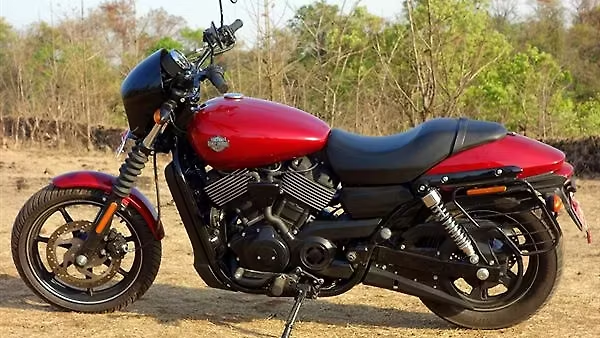
Affordable American Iron: Riding the Street 750
The Harley-Davidson Street 750 holds a special place in motorcycle history as the bike built to open the gateway to the legendary American brand for a whole new generation of urban riders.
The Origin Story
Introduced globally at the EICMA motor show in 2013 and launched for the 2014 model year, the Street 750 represented Harley-Davidson’s first all-new lightweight platform in over 13 years.
To make it affordable, Harley-Davidson adopted a dual-origin manufacturing strategy:
The Americas: Bikes sold in the US, Canada, and Mexico were built at Harley’s factory in Kansas City, Missouri.
Global Market: Bikes for Europe, Asia, and other international markets were completely manufactured and assembled at the Harley-Davidson India subsidiary in Bawal, Haryana. This marked a massive shift, making it an authentic, indigenous cruiser optimized specifically for worldwide street conditions.
1. Engine & Power Performance
The Street 750 brought modern liquid-cooling to Harley’s budget lineup with its newly developed powertrain.
Engine Type: $60^\circ$ V-Twin, 4-Valves per cylinder, SOHC, Revolution X™ engine
Cooling: Liquid-Cooled (essential for tight city traffic)
Displacement: $749\text{ cc}$
Maximum Power: Approximately 47 to 53 bhp (Harley focused more on real-world torque output)
Maximum Torque: $59\text{ Nm}$ @ 4,000 rpm (offering excellent low-end grunt)
Gearbox: 6-speed manual
Final Drive: Low-maintenance belt drive
Top Speed: Approximately $160\text{ to }170\text{ km/h}$
2. Mileage & Fuel Range
Designed to tackle daily city grids alongside casual weekend highway cruising, its economy figures are quite respectable for a middleweight V-Twin.
Real-World / City Mileage: $20\text{ to }23\text{ kmpl}$
Highway Mileage: $25\text{ to }27\text{ kmpl}$
Fuel Tank Capacity: $13.1\text{ Litres}$
Riding Range: Around $280\text{ to }320\text{ km}$ on a full tank.
3. Chassis, Suspension & Brakes
The geometry of the Street 750 is long and low, favoring high-speed straight-line stability and easy foot planting.
Frame: Steel double-cradle frame
Front Suspension: Traditional Telescopic forks ($37\text{ mm}$ inner tubes) wrapped in retro black rubber gaiters
Rear Suspension: Dual gas-charged shock absorbers attached to a rectangular box-section swingarm
Front Brake: $292\text{ mm}$ Single Disc with a 2-piston floating caliper
Rear Brake: $260\text{ mm}$ Single Disc
ABS: Dual-channel ABS (added as standard equipment in later model updates)
Wheels: 7-spoke cast aluminum alloy wheels (Front: $17\text{-inch}$, Rear: $15\text{-inch}$)
4. Dimensions & Weight
Its physical profile is incredibly low-slung, making it highly manageable for shorter riders or cruiser beginners.
Kerb Weight: $233\text{ kg}$ (It feels lighter than it sounds because the center of gravity sits extremely low to the ground)
Seat Height: $720\text{ mm}$ (Unladen, making it one of the most accessible seats on any big bike)
Ground Clearance: $145\text{ mm}$ (Requires caution over tall speed bumps)
Wheelbase: $1520\text{ mm}$ (A long footprint that helps keep it planted on the highway)
5. Styling & Visual Features
The bike championed Harley’s signature “Dark Custom” styling theme:
Blacked-Out Theme: The engine, cooling fins, long 2-into-1 exhaust pipe, and handlebars are completely draped in matte or gloss black rather than traditional chrome.
Minimalist Instrumentation: Features a clean, single round 3.5-inch handlebar-mounted analogue speedometer with a small digital window for trip meters.
Cafe-Style Speed Screen: A small, retro black headlight cowl adds to its sleek, aggressive urban posture.
Pros: Exceptionally smooth and torquey V-twin engine, ultra-low seat height, comfortable riding position for cruising, massive custom aftermarket support.
Cons: The early model generations (2014-2016) received complaints for soft initial front brake bite (upgraded in later variants), low ground clearance can scrape on aggressive road obstacles.